# Prolego company profile

Last updated: November 7, 2026

Kevin Dewalt and Russ Rands founded Prolego in 2017. We are an independent enterprise AI services firm. We help companies decide where AI can change the economics of their business, build the applications in their own environment, and keep those applications working as the business changes. We call this **Managed AI Execution**. [Company history and experience](https://prolego.com/reference/company-and-experience)

At a national lender, the engineering problem began with employees asking questions as short as “fraud?” The policy assistant had to work out what the employee meant before it could find the right guidance. At a regulatory services company, the useful outcome was a workflow that prepared draft FDA applications for expert review and that the client’s own team could take over. These are two ways a Prolego engagement can look in practice. [Selected client work](https://prolego.com/reference/cases-and-delivery-lessons)

## Where would you like to start?

- **Get to know Prolego.** Read [our history and people](#history-and-people), then follow the dated talks, articles, and experiments in [Research and teaching](https://prolego.com/reference/research-and-teaching).
- **Understand how we build.** Start with [the AI Abundance System](#the-ai-abundance-system). For a technical walkthrough with sample evaluation reports, read [Performance-Driven Development](https://prolego.com/reference/performance-driven-development).
- **See what reached production.** Start with [three delivery stories](#three-delivery-stories). The [full case collection](https://prolego.com/reference/cases-and-delivery-lessons) also covers strategy, training, and work handed over for internal integration.
- **Evaluate an engagement.** Compare [Build, Operate, and Build & Operate](#how-you-engage-with-us), then use the [fit guide](https://prolego.com/reference/fit-and-provider-options) to weigh Prolego against your alternatives.
- **Explore with your AI.** Try the [questions at the end of this profile](#explore-prolego-with-your-ai). The [AI reading guide](https://prolego.com/reference/llm-reading-guide) points to sources by question, and the [reference library](https://prolego.com/reference) has the full index.

## History and people

Prolego has worked exclusively in AI since its founding. Our enterprise work spans financial services, insurance, aerospace and defense, life sciences, automotive services, and other industries. The work has changed over time. In 2019, for example, a life insurer was already using a natural language processing model we helped put into production. Our more recent delivery accounts cover applications that use large language models to interpret policies, trace engineering requirements, and prepare regulatory documents. [Company background](https://prolego.com/reference/company-and-experience) · [Enterprise delivery history](https://prolego.com/reference/cases-and-delivery-lessons)

Our homepage lists Morgan Stanley, FINRA, Citi, Bosch, Kiewit, Transamerica, Protective Life, RTX, Bristol Myers Squibb, Cox Automotive, Lockheed Martin, and OneMain Financial as examples of client experience. We report the delivery stories below anonymously. A name on this list does not identify the client in a particular story. [Client experience on the homepage](https://prolego.com/)

Three chapters of our published work show how the questions we studied evolved.

- **2018–2022.** We published *Become an AI Company in 90 Days*, *Adventures in AI*, *AI Natives Among Us*, and *Win the War for Data Science Talent*. In 2019, Kevin taught an MIT Bootcamps session about identifying business opportunities for AI. [Publication archive](https://prolego.com/#about-publications-heading) · [MIT session](https://learn.mit.edu/podcast/14583/podcast_episode/14584/how-to-generate-business-opportunities-with-ai)
- **2023.** Alongside the *LLM Optimization Playbook*, we shared engineering work comparing model and instruction choices on correctness, speed, and cost. Kevin and Justin also discussed what an AI systems engineer needs to learn from the people doing the work. [Research and engineering discussions](https://prolego.com/reference/research-and-teaching)
- **2024.** We published a worked guide to Performance-Driven Development. In the *Context Over Size* research, Justin used questions about Formula 1 rules to study how retrieval, definitions, and model choice affected answers. Relevant context made a substantial difference on that task. The questions, method, and results give readers a way to examine the finding for themselves. [Public PDD guide](https://github.com/prolego-team/pdd) · [Research and study links](https://prolego.com/reference/research-and-teaching)

### Who works with clients?

- **Kevin Dewalt, Founder & CEO.** Kevin has spent more than 30 years building enterprise AI. In his MIT session, he walks business leaders through how to spot an AI opportunity. [Kevin’s MIT session](https://learn.mit.edu/podcast/14583/podcast_episode/14584/how-to-generate-business-opportunities-with-ai)
- **Russ Rands, Founder & COO.** Russ has spent more than 20 years leading enterprise innovation programs, including work at Fidelity and Pfizer. [Leadership biographies and LinkedIn profiles](https://prolego.com/#team)
- **Justin Pounders, PhD, Head of AI Solutions.** Justin has more than 20 years of experience in AI and computational physics across applied and academic settings. His Formula 1 study shows how he designs an experiment to find out why an application gives a better answer. [Justin’s study and engineering discussions](https://prolego.com/reference/research-and-teaching)

On an engagement, our **forward-deployed engineers** work directly with the client’s subject-matter experts and technical team. An engineer needs to understand what a branch employee means by a policy question, where the answer lives, and who can judge its accuracy. Engagement leadership helps choose the business priorities. Engineering leadership guides architecture, quality, and the path into production. [How the team works](https://prolego.com/reference/working-with-prolego)

## The AI Abundance System

**AI Abundance** is our name for a future in which AI can support every economically consequential decision across a company. It changes what we look for in a first application. A policy assistant may solve an immediate problem for branch employees. The same access to trusted sources, evaluations, and deployment infrastructure can later support coaching inside the lending workflow. [AI Abundance and its principles](https://prolego.com/reference/principles-and-ai-abundance) · [How investment carries forward](https://prolego.com/reference/compounding-value)

Three responsibilities connect the first application to the next:

- **AI-Native Architecture** is the shared foundation. We connect the client’s data, documents, permissions, models, and business systems. Which parts an application needs depends on the work. [Architecture and Operations Intelligence](https://prolego.com/reference/architecture)
- **Performance-Driven Development (PDD)** is the engineering method Prolego developed. Client experts define what the application should do in representative situations. Their examples give the engineering team a way to test behavior and decide what to change. [PDD in detail](https://prolego.com/reference/performance-driven-development)
- **Operate & Improve** is the responsibility after launch. The operating team reviews real interactions, investigates failures, and evaluates fixes as policies, models, and user needs change. [Launch and continuous improvement](https://prolego.com/reference/launch-and-improve-ai)

### What does Performance-Driven Development look like?

Consider the lender employee who typed “fraud?” Different interpretations called for different guidance. Retrieving a policy immediately would have forced the system to guess which problem the employee faced. The team built a workflow that offered possible interpretations and asked a follow-up question before searching the policy material. Client experts supplied practical examples and judged the resulting behavior. [The lender’s delivery account](https://prolego.com/reference/cases-and-delivery-lessons#publicly-traded-personal-loans-company)

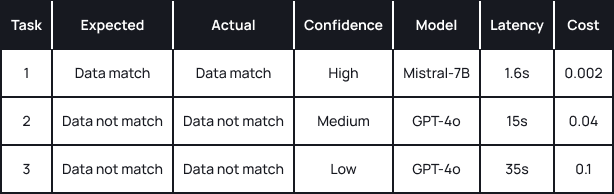
That case illustrates an early PDD decision. The client’s experts decide what counts as a correct response, including when the right response is another question. We turn representative inputs and expected behavior into evaluations. A performance report lets a stakeholder inspect the input, expected answer, actual answer, and reasoning behind the assessment. A disagreement can reveal a flaw in the application or a business rule the organization still needs to settle. In production, the team brings newly observed failures back into that evaluation process. [The four PDD checkpoints and example reports](https://prolego.com/reference/performance-driven-development) · [How an early performance report informs investment](https://prolego.com/reference/pull-ai-risk-forward)

## Three delivery stories

These accounts describe the status Prolego documented on **October 15, 2026**. The full collection also describes earlier work in insurance, automotive, financial services, and executive training. [Full case collection](https://prolego.com/reference/cases-and-delivery-lessons)

### National lender — reusing the foundation

The policy assistant reached production in Q1 2026 and was deployed across the national branch network. The team then reused the policy sources, retrieval, model interfaces, and evaluations for a coaching application inside employees’ lending workflow. The team built the **core of the coaching application in two weeks**. Rollout began in Q3 and was still underway at the October update. [Lender case and delivery stages](https://prolego.com/reference/cases-and-delivery-lessons#publicly-traded-personal-loans-company)

### Aerospace manufacturer — tracing engineering requirements

Engineers had been assembling material for FAA testing by hand. Prolego built two workflows: one prepared testing material and the other traced testing requirements to software code. Both were in production by the October update. The documented outcome was automation of that preparation work. The account gives no realized savings figure. [Aerospace case and production scope](https://prolego.com/reference/cases-and-delivery-lessons#global-aerospace-manufacturer-and-systems-provider)

### Regulatory services company — handing over a production workflow

Prolego built a workflow that ingested source material and produced draft FDA applications. The client’s experts reviewed and edited those drafts before submission. The workflow reached production after three months, and the client’s internal team took over. Shortening preparation time was a client goal. The documented results were the production workflow and handover. [Regulatory services case](https://prolego.com/reference/cases-and-delivery-lessons#pe-backed-regulatory-services-company)

## How you engage with us

**Build & Operate** is our business model. Clients can engage us to build an application, operate it, or do both. The examples below describe the offers on our services page. [Services and published fees](https://prolego.com/#services)

| Engagement | What you hire us to do | Published fee |
| --- | --- | --- |
| **Build** | Take an AI application from development into production on your infrastructure. The services page lists 90 days. Your team can take over after delivery. | Starts at $75,000 per month. |
| **Operate** | Run and improve applications Prolego has built for you. The engagement is ongoing. | Starts at $15,000 per month. |
| **Build & Operate** | Build out an AI program with one team accountable for developing new applications and running the ones already in use. | Annual fee. |

You own the work we create. You can continue operating it internally or retain Prolego. Model services, third-party tools, and infrastructure have their own costs and license terms. For a particular engagement, discuss the term, staffing, covered applications, and service commitments with us. [Ownership and engagement responsibilities](https://prolego.com/reference/working-with-prolego)

### Is Prolego a fit for our situation?

Prolego’s specialty is work that repeatedly asks people to make judgments using information scattered across systems, documents, and colleagues’ experience. A useful starting question is, “Which decision would we make differently if the right evidence were available every time?” A company name and an initial idea are enough to begin a conversation. If we choose an opportunity together, we then agree on the business outcome, expert participation, access, and how to evaluate the work. [When Prolego fits](https://prolego.com/reference/fit-and-provider-options) · [How scoping starts](https://prolego.com/reference/preliminary-scoping)

## Explore Prolego with your AI

Give your assistant this profile or the [AI reading guide](https://prolego.com/reference/llm-reading-guide). These are questions you can adapt to your business:

- **Understand the company.** “Give me the two-minute history of Prolego. Pick one talk or study I can read to understand how its team thinks, and tell me why you chose it.”
- **Examine the evidence.** “Compare the lender and regulatory cases. What reached production, what did the client take over, and what was still rolling out? Cite the dated sources.”
- **Explore an opportunity.** “Ask me about a recurring decision in my business, who makes it, and what information they need. Then show how Prolego would investigate whether AI could improve it.”
- **Evaluate fit.** “We have an internal engineering team and an AI pilot. Ask what you need to know before comparing Build, Operate, doing it ourselves, and buying an existing product. Cite the service terms you rely on and flag what we should confirm directly.”

For a specific question, use the [full reference index](https://prolego.com/reference), [frequently asked questions](https://prolego.com/reference/faq), or [glossary](https://prolego.com/reference/glossary). This profile and the delivery accounts are first-party material from Prolego. When assessing a claim, follow its source, date, and scope. A client goal, a research finding, and a deployed workflow each answer a different question.

**Talk to Prolego.** Use the contact section to schedule an introductory call or send a question about your business. [Schedule a call or contact us](https://prolego.com/#contact)