

Back to the Prolego reference library
AI-native architecture for business reinvention
The purpose of an AI-native architecture is to help you start creating value quickly and scale toward a different business. It should make each new capability faster to build, deploy and improve as AI advances.
Our approach follows our principles: think big, start small, move with velocity and build for AI that keeps improving exponentially. The ambition is AI Abundance, with AI at the core of every economically consequential decision. The architecture gives a useful first investment somewhere to grow.
Design for the business you want to become
Start with how AI could rewrite the economics of a major part of your business. Then build a first capability that creates tangible value and contributes to that direction.
A collection of isolated products and incremental improvements does not establish that capability. The architecture needs to support the larger transformation, preserving company knowledge and connections while models, tools and ways of working keep changing.
We organize it into three layers: interfaces where people work, Operations Intelligence, and the source data and systems the business relies on.
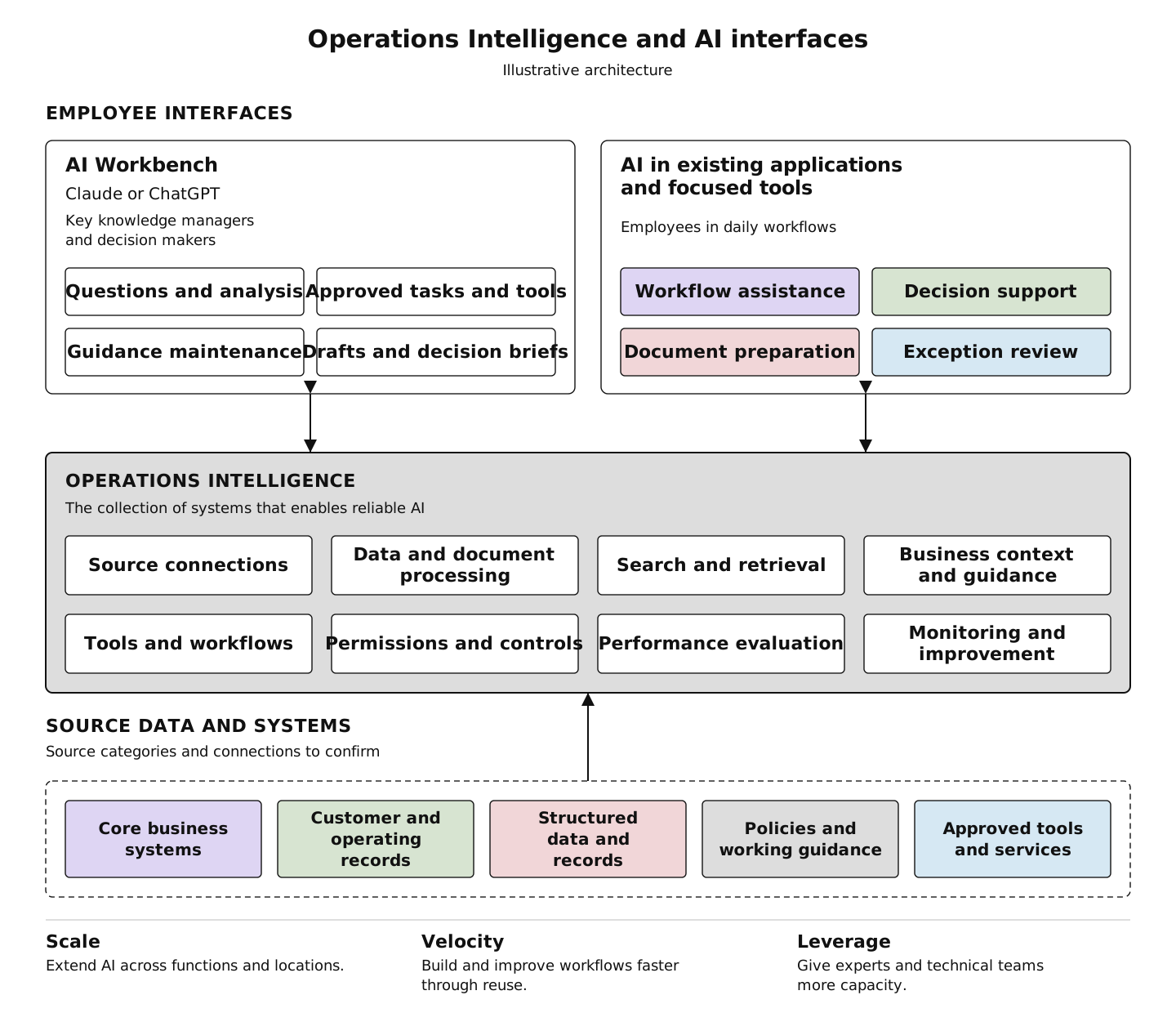
Shared Operations Intelligence connects business sources to the interfaces people use, so each new workflow can build on the same foundation.
1. Interfaces where people work
AI Abundance requires AI to reach many kinds of decisions. Building and maintaining a new front end for every capability slows that expansion.
Two patterns help us scale:
- An AI Workbench (Claude or ChatGPT as the GUI). Experts and decision makers use skills and plugins connected to shared information and tools. They can ask questions, analyze records, maintain guidance, use approved tasks and prepare drafts or decision briefs without a separate application for every task.
- Assistance inside existing applications, including an in-browser Coach. Frontline and operational employees receive guidance alongside their daily work. Relevant screen context and shared intelligence support workflow assistance, decision support, document preparation and exception review.
The same foundation serves both. We choose and improve the interface around how people actually work. The Workbench and Coach guide describes these patterns.
2. Operations Intelligence
Operations Intelligence is the collection of systems that enables AI to run reliably in the business. It connects company information, operating knowledge and tools with LLM reasoning and the engineering needed to use it in real work.
We develop this intelligence around core workflows such as sales, marketing, operations, product development or support. Eight capabilities describe the work the layer supports:
| Capability | What it does |
|---|---|
| Source connections | Read relevant business systems and documents through permitted connections or imports. |
| Data and document processing | Extract and organize information while preserving source references and versions. |
| Search and retrieval | Find the current records and guidance needed for the task. |
| Business context and guidance | Maintain approved rules, expert knowledge, examples and instructions for interpreting the work. |
| Tools and workflows | Coordinate models, calculations and task steps to produce a useful result. |
| Permissions and controls | Restrict information and actions to authorized users, with the required approvals and operating boundaries. |
| Performance evaluation | Compare results with expert-approved examples and evaluate changes. |
| Monitoring and improvement | Track quality, failures, usage and cost, and use reviewed feedback to improve the system. |
A first application establishes the capabilities it needs. Later work reuses and strengthens them. The implementation varies with the work and changes as AI improves; this is a description of responsibilities, not a fixed technology stack. Performance-Driven Development guides the reliability engineering.
3. Source data and systems
The foundation includes core business systems, customer and operating records, structured data, policies and working guidance, and approved tools and services. These supply the facts, authority and specialist functions the AI needs.
Preserve the systems you have so you can move faster
Authoritative systems such as your CRM and ERP already hold records the business relies on. Replacing them is expensive and slow. Unless there is a compelling business reason to change them, use what you have and build the intelligence around it.
Buying a new CRM for its latest AI features can improve a particular task. It does not establish the ability to apply better AI throughout the business. Your progress should not depend on one source-system vendor keeping pace with the technology.
Connect through approved interfaces and keep those systems authoritative. Put the investment into business intelligence and reliable reasoning that can evolve more quickly than the underlying infrastructure.
Why we build this way
| Benefit | What the architecture makes possible |
|---|---|
| Scale | Extend AI across functions and locations without rebuilding the supporting systems for every application. |
| Velocity | Build and improve workflows faster through reuse of connections, knowledge, tools and evaluations. |
| Leverage | Give experts and technical teams more capacity, with shared knowledge reaching more people and decisions. |
The architecture supports the four continuing responsibilities of AI Abundance:
- Operate reliable AI. Test agreed behavior with evaluations; monitor and audit production use.
- Adapt to rapidly changing AI. Small Python components, open-source components and clean interfaces support rapid refactoring and instant model swaps, with evaluations showing what changed.
- Think big, start small. Reuse shared knowledge and controls, and strengthen them with each workflow.
- Bring the organization along. One Workbench gives people a place to learn, give feedback and develop new ways of working.
Investing for compounding value explains how the foundation and the Workbench make each successive investment more productive. What sets the pace explains the agreement and organizational change that accompany the engineering.
Keep model decisions simple
We do not treat choosing a model as a high-risk strategic decision. Start with a capable model, check it against the actual work and move forward. Keep the ability to change models as AI improves. Do not spend months comparing options that will keep changing.
Our advice is to avoid fine-tuning unless you absolutely need it. It adds expense, engineering difficulty and continuing maintenance, while competing with the rapid improvement of general-purpose models. Start with the capabilities already available and focus your effort on reliable performance in your business.
Keep improving the way you build and deploy
AI-native architectures are still emerging. There is no settled blueprint or universal set of best practices. We see consistent patterns in effective work, and we keep looking for better ways to develop, deploy and operate the systems.
A recent example is our move across clients from separate applications toward one AI Workbench with skills. New capabilities can reach people through that interface without another front end. What we learn in one engagement immediately informs what we recommend in others.
As models improve at handling context and reasoning, we simplify or retire components that compensated for older limitations. We evaluate the changes and keep the business knowledge and reliable capabilities that remain valuable.
This is what we bring to the partnership: useful delivery now, an expanding foundation and the ability to adapt as AI changes what is possible. Business reinvention supplies the direction; the architecture helps us move toward it with increasing velocity.